
Clay, bentonite or a liner: how do you seal a pond on Whidbey Island?
It depends on the ground under the pond. Compacted clay works in soil with enough clay. Sandy or silty soil takes bentonite in thin compacted lifts. A liner on a cushion fits ground that will not seal, with drainage below if water sits high. Big digs can need a county grading permit, and pond water a state water right.
Why do some ponds on Whidbey Island leak?
Every pond loses some water. A guide on leaky ponds says a well-built pond on good soil can seep about one inch a month. If yours drops much faster, or will not hold water at all, the ground under it is the first suspect.
On Whidbey Island, that ground changes from spot to spot. Much of the island has dense glacial till under the topsoil, called hardpan here. Water stops on the till and moves sideways to the low spot. A basin dug into tight till can hold water.
Sand and outwash let water through, so a pond dug into them leaks. One lot can hold clean sand, till, cobble and groundwater.
Pond sealing is the fix for ground that leaks. The federal Natural Resources Conservation Service (NRCS) has a pond sealing standard for compacted soil and another for liners. Both apply where the natural soil leaks too much.
Compacted clay: when the soil you dig will hold water
If the basin’s own soil holds enough clay, that soil can seal the pond. Checking for it is where our pond construction on Whidbey Island starts. NRCS calls the result a compacted soil liner, built from compacted soil with or without amendments.
How much clay is enough? The leaky pond guide sets a minimum of 20 percent clay for good compaction. A basin of coarse soil may need a blanket of soil with more clay spread over it.
Thickness follows depth. The NRCS standard for Washington sets a minimum by the pond’s design depth. For a pond up to 16 feet deep, the compacted soil liner is at least 12 inches thick. Deeper ponds need more.
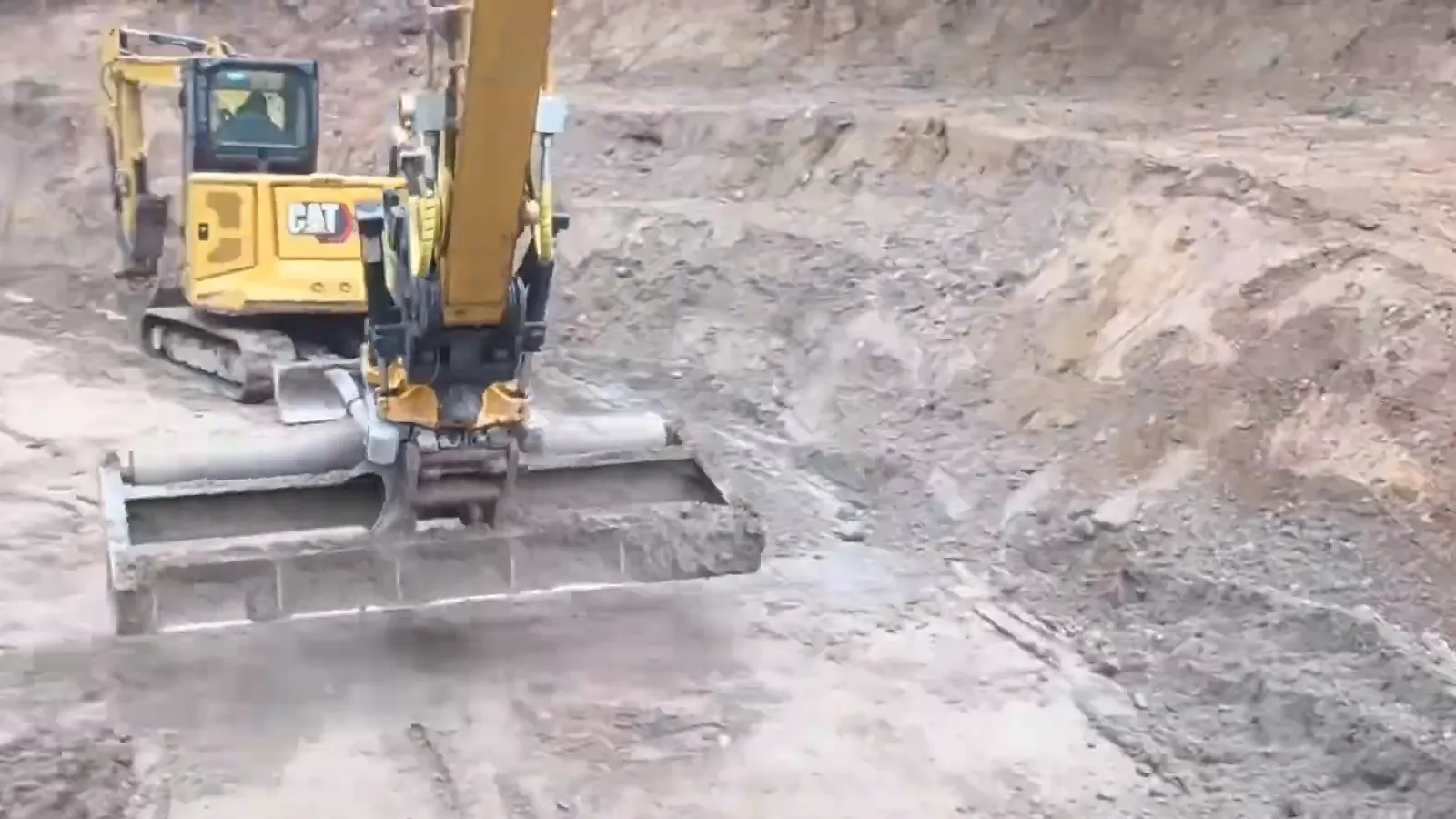
The liner goes in as thin lifts, and each lift is compacted before the next one goes on. We compact them with the roller compactor attachment on our excavator. The tilt rotator on our excavators shapes the banks to the planned slope.
A clay pond liner needs protection. NRCS says to guard it against water level swings and against drying and cracking. Exposed clay that dries out can crack and leak.
Bentonite: when sandy or silty soil needs help
Bentonite is a clay that swells to about 15 times its original volume in water. Mixed into sandy or silty soil and compacted, it closes the gaps that let water out. NRCS treats bentonite pond sealing as an amended compacted soil liner.
The type matters. The Washington standard calls for sodium bentonite with a free swell of at least 22 milliliters. Free swell is a lab test of how much the clay grows in water.
For a clean water pond, the standard puts the treated soil in lifts no thicker than 6 inches. Bentonite dust is a hazard, so the standard has everyone on site wear masks and goggles.
The leaky pond guide names three main methods:
- Mixed blanket: bentonite mixed into the soil of a drained pond bottom, then compacted.
- Pure blanket: a layer of bentonite alone, spread on the drained bottom and covered with soil.
- Sprinkling: bentonite scattered on the water over the leak, where it sinks and swells.
Water chemistry can stop it. Bentonite will not swell in water with large amounts of mineral salts or acids.
Liners: when the ground will not seal
Some ground will not seal with clay or bentonite. Then the answer is a liner: a geomembrane sheet or a geosynthetic clay liner (GCL). NRCS has a separate standard for them, and liner installation is part of our pond work.
NRCS calls for a cushion between the liner and any sharp, angular stones that could damage it. The cushion can be a heavy nonwoven geotextile or at least 6 inches of suitable soil. On island ground mixed with rock, that cushion matters.
PVC liners and GCLs get at least 12 inches of soil cover. Lined side slopes can be no steeper than 2:1, which means 2 feet across for every foot of rise.
High water is the big risk. Every geomembrane liner needs drainage underneath when the pond bottom sits within 2 feet of the seasonal high water table. Without it, groundwater pressure can make the liner float. On the island, we check for winter water perched on the hardpan before a liner goes in.
Liners have other enemies. NRCS says to pull roots from trees and large shrubs at first appearance. Burrowing animals and livestock can puncture a liner. NRCS also does not recommend PVC for ponds that raise fish, because its stabilizers can leach out.
Clay, bentonite or a liner: how do they compare?
Each method fits a different kind of ground. The pond liner vs clay question comes down to the soil you dig.
| Method | What the ground needs | Where it fits | What goes wrong |
|---|---|---|---|
| Compacted clay | At least 20 percent clay, compacted in thin lifts | A basin dug into soil that already holds clay | Exposed clay dries and cracks when the water drops |
| Bentonite | Sodium bentonite worked in, in lifts no thicker than 6 inches | Sandy or silty soil that leaks too much | It will not swell in water with a lot of mineral salts or acids |
| Liner | A cushion of heavy geotextile or at least 6 inches of soil | Ground that will not seal | Roots, burrowing animals and livestock puncture it, and high water can float it |
A test pit shows which row fits your ground.
Do you need a permit or a water right for a pond in Island County?
Possibly, and they are two separate checks: a county grading permit and a state water right.
Island County requires a grading permit for land disturbing work unless its code exempts it. The code’s examples include excavation and fill that add up to more than 500 cubic yards. Clearing, filling or excavation in any amount also counts within 200 feet of a regulated shoreline. The same goes for steep slopes, geologically hazardous areas and wetlands.
The code lists exemptions too, so ask the county how they apply to your pond. The property owner applies, or someone the owner names in writing. We look at the ground and the county maps with you and build to the conditions written on the permit.
The water right is the state’s question. Washington’s Department of Ecology says you need a water right to use any amount of surface water. State pond construction rules say a pond that diverts water needs the water right before any water is diverted. That rule does not apply to stormwater ponds built landward of the ordinary high water line.
If you are unsure about your pond’s water source, Ecology recommends a pre-application consultation with its regional staff. For edge cases, ask the county or ask Ecology.
Can a leaking pond be sealed without draining it?
Sometimes. With the sprinkle method, the pond does not need to be drained. The exact location of the leak must be known, though, because the bentonite goes on the water right over it.
It is the least reliable of the three methods. The leaky pond guide says sprinkling is not as successful as the mixed or pure blanket methods. Those two go on a drained pond bottom.
Bentonite also takes time. Some seepage is expected for up to a week after it goes in, so judge the result after that.
The same guide calls reconstruction perhaps the best option for stopping a leak. It is also the biggest job: draining the pond, then sealing the basin or repairing the dam.
What we look at before we dig or reseal a pond
We start with the soil. A test pit dug with our excavators shows what sits under the basin, whether clay, till, sand, cobble or water. That points to compacted clay, bentonite or a liner.
Next is the water source. Runoff, a spring or a stream each raise their own questions, including the water right. Where heavy rain heads for the basin, drainage work that moves runoff around the pond gives it a controlled path.
Then we look at winter water. How high it sits in a wet winter decides whether a liner needs drainage underneath.
Last come the banks. Lined slopes stay at 2:1 or flatter, and roots near a liner get pulled as they appear. Once the basin is dug, we move to grading the banks and the ground around the pond. It can end with boulder work and planting around the edge. Plant with the liner in mind.
A pond on a lot with a new build fits into the excavation and site development plan. We check the county maps with you for the shoreline, slope and wetland rules. Then you get a written price.